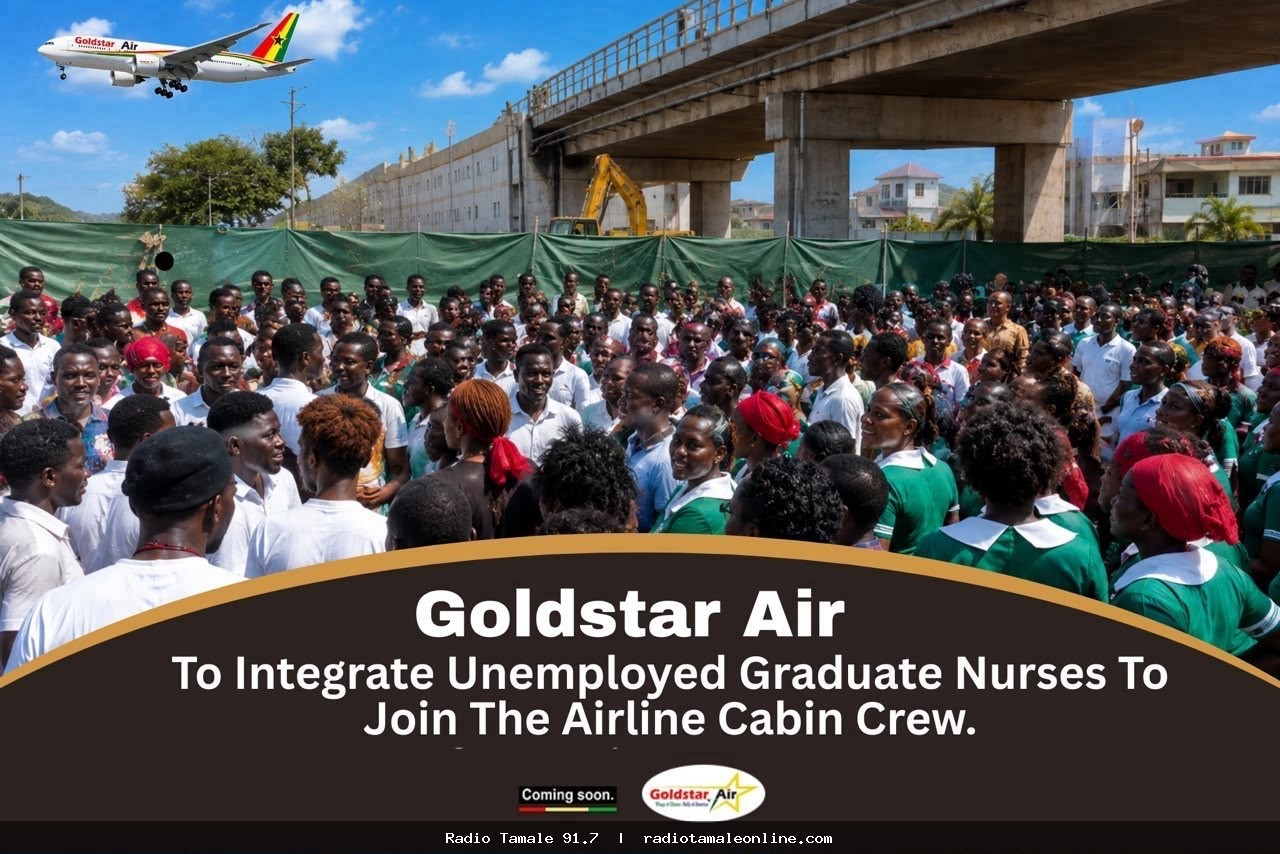
Undisputed airline Goldstar Air, the belly of America and wings of Ghana, is set to integrate qualified unemployed graduate nurses into the airline’s cabin crew as part of Goldstar Air’s over two million direct and indirect job opportunities. The airline’s employment initiative is a bold human-capital strategy that recognizes the extraordinary value of combining healthcare knowledge, hospitality, aviation professionalism, and compassionate service.
Goldstar Air’s initiative is significant in Ghana, where the journey from graduation to stable professional employment can be difficult for many young professionals. University or professional qualification must open a door to opportunity, but too often, Ghanaian graduates find themselves waiting for vacancies, recruitment exercises, postings, or permanent employment while their skills gradually become underutilized. The situation can be frustrating for highly trained professionals whose education represents years of sacrifice by themselves and their families.
The airline’s integration pathway aims to communicate a different message: your qualification is not the end of your journey; your knowledge will become the foundation for another professional opportunity. Graduate nurses who have developed competencies in patient care, communication, observation, teamwork, confidentiality, emergency response, and compassionate interaction have already cultivated qualities that will be valuable in aviation.
Goldstar Air will provide comprehensive cabin crew training to complement their existing skills and prepare them for successful aviation careers, subject to each candidate satisfying all applicable aviation, medical, regulatory, and employment requirements.
Goldstar Air will build the cabin crew graduate nurses initiative around the principle of “From Healthcare to High-Flying Service” and a culture in which the phrase “care in the air” becomes more than a slogan. It will represent an approach to passenger experience rooted in professionalism and respect. The cabin crew member will no longer simply the person who welcomes passengers aboard an aircraft, demonstrates safety procedures, and serves meals and refreshments.
In the 21st century where aviation is becoming increasingly sophisticated, Goldstar Air’s cabin crew professionals will be ambassadors of the airline, guardians of passenger safety, providers of reassurance, customer-service specialists, emergency-response team members, and representatives of the culture and values embodied by the United States and Ghanaian flags and identities that the airline carries into the international skies.
Goldstar Air therefore sees an important opportunity to connect two professions that share one fundamental responsibility: caring for people. Nursing is built around compassion, discipline, observation, communication, responsibility, and the preservation of human dignity. Aviation cabin service, when professionally executed, requires many of those same qualities.
Creating a structured pathway through which eligible graduate nurses will receive aviation-specific training and compete for cabin crew positions, Goldstar Air will also collaborate with selected nursing institutions to transform Ghana’s employment challenge into an opportunity for professional reinvention while simultaneously building a cabin crew workforce enriched by healthcare knowledge, emotional intelligence, and a strong culture of service, in pursuit of the airline’s Project $1 Trillion Foreign Reserve Goal.
The United States and Ghanaian registered company, Goldstar Air, with an issued Air Carrier Licence (ACL/N-SCH No. 0239) from the Ghana Civil Aviation Authority (GCAA) to operate passenger and cargo services across West Africa and on intercontinental routes, is expecting the Director-General of the Ghana Civil Aviation Authority, Rev. Stephen Wilfred Arthur, to do the needful by tasking the Safety Department to get a qualified third party as a solution to finalize Goldstar Air’s wide-body aircraft Safety Certification (AOC) process immediately. The engagement of a third-party service will attract an administrative fee, which the airline will be required to pay, and Goldstar Air is ready and willing to pay.
The issue of inviting a third party to a meeting can be resolved efficiently in just 20 minutes, with all parties reaching an agreement on the timing and performance schedule (Schedule of Events) for the final certification process to set Ghana free forever. The completion of Goldstar Air’s Safety Certification will enable the change of the airline’s wide-body aircraft nationality, allowing it to be registered under the Ghana Aircraft Registry (State of Registry), thereby enhancing Ghana’s broader aviation reputation.
The Head Pastor of Kingdom Family International Church at Abeka Lapaz and Director-General of the Ghana Civil Aviation Authority, Rev. Stephen Wilfred Arthur, must understand that any prolonged delay in Goldstar Air’s Safety Certification process represents appalling injustice that has ruined lives, caused irreparable harm, disconnecting people from God and a crime to humanity.
The Director-General should remember that his church’s passion is to obey God, expand His Kingdom, and transform lives here on earth through a dedicated life of holiness, worship, and love.
The country’s future growth hinges on the success of Goldstar Air’s employment drive, which is poised to unlock Ghana’s productivity potential and create enormous opportunities in aviation, tourism, logistics, agriculture, manufacturing, technology, mining, energy, education, and international trade.
The airline is strategically positioned within West Africa to create over two million direct and indirect job opportunities and to serve as a gateway to the African continent. The Ghanaian youth cannot wait any longer in the ghettos; they need their well-paying jobs that will enable them to improve their lives and support their families, communities, and churches through tithes and other contributions.
Goldstar Air also sees the delayed issuance of its Safety Certificate as hindering Ghana’s growth and development plans, and this setback can also be linked to nepotism and cronyism, including selective retirement ages within the Ghana Civil Aviation Authority. leads to corruption, wasting taxpayers’ money, wilfully causing financial loss to the state, and sabotaging the government’s efforts of the Resetting Ghana agenda to a New Economy.
The Director-General of the Ghana Civil Aviation Authority, Rev. Stephen Wilfred Arthur, must understand that his tenure as a Union Chairman is over and that he is now serving in a new role as the overall head of the Authority. It is also essential for a Director-General of any organization to step aside when continuous leadership compromises organizational integrity, performance or strategic alignment. Therefore, the persistent failure the Rev. Stephen Wilfred Arthur to instruct the Safety Department to get a third party to finalize the airline’s Safety Certification process signals the need for new leader and a normalization team.
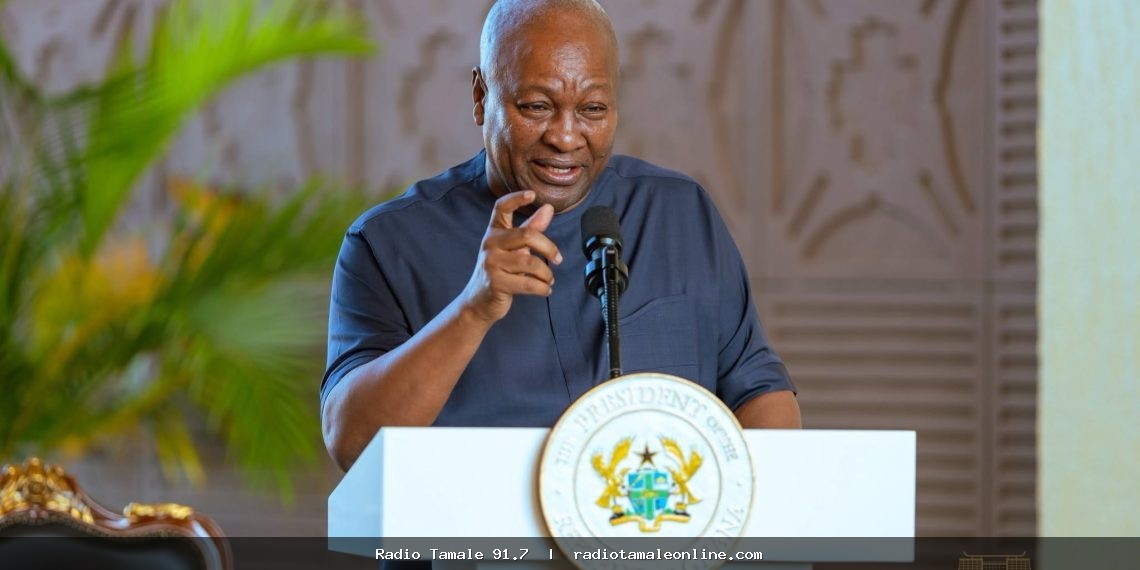
President of Ghana, His Excellency John Dramani Mahama, has urged all government appointees to discharge their responsibilities with integrity, diligence, and humility while adhering to established administrative procedures and supporting the effective implementation of government policies. The statement cautioned that conduct undermining government cohesion, institutional authority, or the implementation of government programs would not be tolerated. It also reminded appointees that public office is a privilege and carries a responsibility to serve the Ghanaian people.
Goldstar Air, firmly established on the unshakable promise of God’s covenant faithfulness, has entered a period of renewed growth. The airline’s founding principles are rooted in the teachings of God’s Word. These principles will continue to demonstrate honesty, integrity, and service in every aspect of the company’s operations, guiding Goldstar Air’s mission to serve humanity. The airline’s 24-hour operations model resonates with Ghanaian broader aspirations for industrialization, regional integration, and economic diversification.
Goldstar Air’s vibrant aviation initiative will support all three objectives by facilitating trade, strengthening logistics networks, and connecting local producers with global markets. Continuous operations will amplify these benefits by maximizing infrastructure utilization and economic output. The airline’s 24-hour operational model symbolizes movement: movement of goods, movement of people, movement of ideas, movement of investment, movement of opportunity, and movement of hope.
According to Ghana Government Statistician Dr. Alhassan Iddrisu, Ghanaian workers are producing more than three times as much as they did three decades ago, but the gains have not translated proportionately into higher wages or better-quality employment. He further said that output per worker increased by about 240.00% between 1991 and 2022, while pay in most sectors rose more slowly than productivity. He questioned, if workers are producing so much more, why doesn’t every worker feel it in their pockets.
Ghana’s economic expansion came from adding more capital, including investment and machinery, rather than using existing resources significantly more efficiently, while the labour market remains one of the clearest weaknesses. Many workers are moving into lower-productivity work rather than higher-productivity work, highlighting a structural problem in which employment growth is not always occurring in sectors capable of generating higher incomes and stronger productivity.
Dr. Iddrisu argued that government policy should increasingly direct investment toward sectors capable of creating both better jobs and higher output while helping informal businesses transition into the formal economy. He further said that businesses need to invest in skills and technology, create decent jobs, and ensure that productivity gains are reflected fairly in compensation. Goldstar Air’s 24-hour operations and its universal pay structure are crucial in addressing these issues of unemployment and underemployment.
The airline acknowledges Ghana’s evolving economic landscape, where one of the most pressing and emotionally resonant realities confronting Ghanaians is unemployment, alongside the persistent gap between effort and reward for the average worker. For many hardworking Ghanaians, the dignity of labour has not always been matched by the dignity of income, a situation Goldstar Air aims to improve through its impact on the Ghanaian pay structure.
Both urban and rural communities, individuals wake up each day with determination, skills, and a willingness to contribute meaningfully to society, yet the compensation they receive often falls short of what is required to sustain a decent standard of living. The notion that a minimum-wage worker earns the equivalent of under 25 cents an hour, when viewed through the lens of global economic comparisons, reflects a broader systemic challenge that goes beyond individual productivity and speaks directly to the structure of opportunity within the economy.
Goldstar Air, the belly of America and wings of Ghana, will help transform Ghana’s minimum wage, currently under 25 cents (a quarter of a dollar) per hour, or the daily minimum wage of GH₵21.77 (under $2 a day) as of January 1, 2026, for the average Ghanaian worker into a living wage. This current minimum wage, calculated over a period of 27 working days, is approximately GH₵587.80 ($50) and applies to workers in Ghana, although enforcement has historically been a challenge, with approximately 28 percent of workers in the informal sector earning below the national minimum-wage threshold.
This stands in stark contrast to daily pet-care expenses in more advanced countries. Yet within this challenge lies a profound opportunity for transformation through Goldstar Air’s employment initiative.
Unfortunately, a significant number of workers struggle to afford rent, and the fear of homelessness drives some to live in slums, a situation that raises serious human-rights issues. This situation is alarming and contributes to rising social challenges, including crime, particularly in areas lacking proper town planning. Under such conditions, economic growth, even when present at the macroeconomic level, does not always translate into improved living standards for the broader population.
Workers travelling from Kasoa to Accra Airport face a significant financial burden, with public transportation costs amounting to GH₵15 one way and GH₵30 for a round trip, exceeding their daily minimum wage and return home in debt. Even without accounting for food, drinks, toiletries, the upkeep of their children, and worst of it all, they cannot buy sachet water to drink.
It is within this context that Goldstar Air’s aviation initiative emerges as one of the most powerful catalysts for wage transformation and as an answer to many Ghanaian youth who continue to ask whether it is a crime or a curse to be born in Ghana. Making the situation a national security threat.
Goldstar Air’s biweekly and universal pay structure will ensure that employees within the airline, regardless of their background or country of stationing, are compensated fairly based on transparent benchmarks and a U.S.-dollar-based compensation structure. This creates a standard that recognizes the value of all forms of Goldstar Air’s 24-hour service. It is a step toward eliminating international wage discrimination, addressing income inequality, and setting an example that will have broader effects across the Ghanaian labour market.
The issue of fair and consistent compensation is central to the economic well-being of any society, and in Ghana, it has long been a source of concern and debate. This initiative will also seek to discourage embezzlement, which can occur when opportunity, financial pressure, and rationalization align; therefore, the airline’s effective strategies are designed to address all three factors.
Goldstar Air commends Ghana’s President, His Excellency John Dramani Mahama, for his announcement that the Government plans to invest GH₵2.5 Billion annually in five key sectors of the economy under its proposed New Economy initiative, aimed at creating jobs and opportunities for young people. The announcement was made during an accountability engagement in Wa on September 13, 2026, as part of his Resetting Ghana Tour of the Upper West Region. President Mahama further stated that the Minister of Finance would unveil the initiative in the 2027 Budget Statement, with investments targeted at sectors including pharmaceuticals, tourism, power generation, agriculture, and agro-processing.
He indicated that these investments would not be government businesses and that the Government would not establish state-owned enterprises with the GH₵2.5 Billion allocated annually. Instead, the funds would go to the private sector to establish and expand businesses. His Excellency John Dramani Mahama therefore urged entrepreneurs and private-sector operators to take advantage of these opportunities to expand their businesses and create employment for the youth.
The future of every nation is ultimately determined not by the abundance of its natural resources, the size of its economy, the height of its buildings, or even the sophistication of its infrastructure, but by the extent to which it can unlock the productive potential of its people. Human capital remains the most valuable asset of any country, and nations that create opportunities for their citizens to work, innovate, produce, and contribute meaningfully to economic development invariably position themselves for long-term prosperity.
Throughout history, the most successful economies have demonstrated that sustainable growth is built on employment, skills development, entrepreneurship, productivity, and the ability to transform human potential into economic value. Goldstar Air’s employment drive holds the key to Ghana’s future growth by unlocking the productive potential of Ghanaians for a New Economy and propelling the airline toward its ambitious Project $1 Trillion Foreign Reserve Goal.
According to the Chairman and Chief Executive Officer of Goldstar Air, Eric Bannerman, the company’s integration of qualified unemployed graduate nurses into the airline’s cabin crew will be approached professionally and responsibly. Nursing qualifications will not automatically be treated as equivalent to aviation qualifications, and working as cabin crew is not a substitute for practicing nursing.
Rather, Goldstar Air’s initiative will provide an intentional bridge between existing professional competence and the distinct technical, safety, and customer-service requirements of commercial aviation. Eligible candidates must meet Goldstar Air’s recruitment standards and all applicable regulatory requirements, complete approved cabin-crew training, demonstrate proficiency in aviation safety procedures, emergency protocols, customer service, security awareness, and satisfy all relevant medical, language, documentation, operational, and other required competency standards.
The strength of the initiative lies precisely in this integration: not placing nurses into aircraft cabins simply because they are nurses, but recognizing their transferable competencies and providing them with the aviation training necessary to become excellent cabin-crew professionals who will also appropriately assist passengers with medical needs and healthcare-related concerns within the limits of their training and applicable regulations.
Goldstar Air, the belly of America and wings of Ghana, modern aircraft cabin is a unique environment. Hundreds of people from different backgrounds, cultures, ages, and circumstances will occupy one confined space while travelling thousands of feet above sea level. The airline’s cabin crew will create an environment that is safe, orderly, professional, and reassuring from boarding until disembarkation. Passengers may arrive tired, anxious, excited, confused, unwell, unfamiliar with the aircraft environment, or travelling under emotionally difficult circumstances.
The airline’s cabin crew will also communicate clearly, remain calm under pressure, observe passenger behaviour, respond appropriately to unexpected situations, and maintain professionalism even when circumstances become challenging. These demands make the healthcare background of graduate nurses particularly relevant from a human-capital perspective.
Nurses are accustomed to working with people in vulnerable situations, communicating with individuals under stress, and maintaining composure when others may be frightened or uncomfortable. These qualities are not substitutes for aviation competencies, but they are valuable foundations upon which Goldstar Air’s aviation-specific skills will be built.
Goldstar Air’s initiative will therefore become a model of skills conversion. Rather than viewing employment pathways as rigidly divided by profession, the airline will identify the transferable competencies contained within different professional backgrounds and build structured training around them. The nurse who becomes a member of the airline’s cabin crew will not abandon the value of their nursing education.
Instead, that education will become part of a broader professional identity. Unemployed graduate nurses will bring an understanding of human behaviour, empathy, communication, hygiene, teamwork, and emergency awareness into a new environment while acquiring the aviation knowledge necessary for their new roles. Goldstar Air will not merely be recruiting employees; the airline will be investing in adaptable professionals capable of learning, transitioning, and contributing across industries.
The airline’s initiative also reflects the changing nature of employment in the 21st century. Careers are increasingly multidimensional. Therefore, a person’s university qualification may define their first professional identity, but it does not necessarily define every role they can perform throughout their working life. The most successful organizations increasingly value transferable competencies alongside academic qualifications.
Communication, emotional intelligence, adaptability, teamwork, problem-solving, professionalism, and the capacity to learn are powerful assets across industries. Goldstar Air will therefore demonstrate that Ghanaian graduates should not be defined solely by the scarcity of vacancies within their original professions. They can be trained to enter adjacent industries where their existing capabilities can create competitive advantages.
Each year, Ghana’s tertiary institutions produce approximately 300,000 graduates, yet only about 10 percent secure employment within the first year after graduation. Significant percentage fail to obtain stable formal-sector employment or face underemployment. Goldstar Air’s operations stands as a powerful initiative capable of supporting the 24-hour economy while addressing youth unemployment and economic stagnation. While other efforts exist, few match the scale, integration, and multiplier effect envisioned for a fully operational Goldstar Air.
Through aviation development, the airline aims to address skills mismatches, industrial underdevelopment, regional inequality, and limited global market access simultaneously. Goldstar Air represents an integrated solution that combines corporate discipline, international standards, and a strong Ghanaian commitment to youth empowerment and development.
Goldstar Air’s 24-hour operations will transform the Tamale metropolis into a centre of aviation excellence and a leading hub for aerospace development in West Africa as part of the New Economy. Goldstar Air will seek certifications and partnerships with internationally recognized aviation organizations, including the United States Federal Aviation Administration (FAA), the European Union Aviation Safety Agency (EASA), the Ghana Civil Aviation Authority (GCAA), the International Air Transport Association (IATA), and the International Air Transport Association Operational Safety Audit (IOSA), to establish a world-class training environment for future aviation professionals.
The airline will also collaborate with selected Junior High Schools and Senior High Schools across Ghana to introduce students to aviation through specialized mentorship programmes and pipeline initiatives designed to spark interest in aviation careers. These programmes will offer students opportunities to explore pilot-training facilities, experience flight-simulation technology, interact with aviation professionals, and understand the wide range of career opportunities available within the aviation and aerospace industries.
The airline will also develop a specialist “health-aware cabin service” culture while ensuring that all medical capabilities remain within appropriate regulatory and professional boundaries. Cabin crew will receive robust training in relevant emergency procedures, passenger assistance, hygiene, infection-control awareness, first-aid principles, and appropriate response protocols as required by aviation authorities and airline policy.
Graduate nurses participating in the training will potentially become particularly strong performers in these areas after receiving the same mandatory aviation training as other crew members. Their healthcare background will complement, not replace, the airline’s formal safety training.
The initiative will also strengthen Goldstar Air’s reputation as an employer committed to innovative workforce development. The airline will deliberately search for talented graduates in all the 275 constituencies in Ghana, beyond conventional aviation recruitment channels, demonstrating an understanding that excellence can come from unexpected places.
Goldstar Air will create a talent pipeline that includes nurses, teachers, hospitality professionals, language specialists, customer-service professionals, graduates in communication, and professionals from other fields whose transferable skills will be developed into aviation competencies. This will broaden the recruitment ecosystem and give Ghanaian graduates more opportunities to participate in the country’s aviation industry.
The airline industry itself requires a wide range of professionals, and cabin crew is only one visible component. Goldstar Air will create over two million direct and indirect job opportunities across ground operations, customer service, cargo, administration, information technology, finance, marketing, engineering, safety, training, and others.
The graduate-nurse initiative will become a flagship example of a broader philosophy: Goldstar Air’s creation of additional employment pathways will contribute to Ghanaian productivity. The airline’s graduate-nurse integration initiative will be one example of how private-sector expansion can create new channels for existing human capital.
Goldstar Air, “the Belly of America and wings of Ghana,” has introduced a 24-hour service initiative called “Pocket Change for Smile” to help fund dialysis machines. This initiative will raise funds through donations from passengers who contribute their spare coins, whether in foreign or local currency, to support the programme. The airline will encourage passengers to donate their spare change from international travel into designated boxes located in airport lounges, check-in counters, departure waiting areas, and onboard flights before arrival at their destinations.
The airline’s ongoing commitment to Corporate Social Responsibility (CSR) through Pocket Change for Smile aims to distribute dialysis machines nationwide to improve healthcare services for kidney patients in Ghana. It will also provide quality medical care for the airline’s retired employees suffering from kidney disease. Goldstar Air remains committed to improving lives and supporting its valued workforce.
The airline will collaborate with international organizations that share a similar vision, encouraging them to join the Pocket Change for Smile programme to reach people in need worldwide through this impactful initiative. Similar partnership between UNICEF and various international airlines has already demonstrated the potential of such programmes. Since its launch, UNICEF’s Change for Good programme has generated over $185 million, showcasing how airlines can engage travellers, raise awareness, and demonstrate a shared commitment to social responsibility while increasing customer loyalty.
The airline, as part of its Corporate Social Responsibility efforts, has donated Personal Protective Equipment (PPE) to the Accra Regional Hospital (Ridge Hospital), Accra Psychiatric Hospital, Dansoman Polyclinic, Weija-Gbawe Municipal Hospital, Kaneshie Polyclinic and others. Goldstar Air will continue to support health facilities nationwide to enhance healthcare delivery for kidney patients and alleviate the financial burden on employees and their families.
Mr. Bannerman emphasized that the airline’s unemployed graduate nurses initiative will also create opportunities for continuous learning as part of the New Economy. Every graduate represents an accumulation of personal effort, family sacrifice, institutional resources, and human-capital investment. When graduates remain economically inactive for prolonged periods, society loses part of the potential return on that investment. Cabin crew members will not simply complete their initial training and stop developing.
Goldstar Air will build professional-development pathways covering leadership and specialized operational skills. Over time, outstanding employees will progress into senior cabin crew positions, trainers, supervisors, recruitment roles, or other relevant functions, depending on organizational needs and qualifications. This will create a career rather than merely a job. Ghanaian educated workforce will be connected to emerging industries in the country.
When a young person begins to wonder whether their birthplace is a curse or a crime, it is not simply an expression of personal despair; it is a signal that society must respond with courage, innovation, and leadership. It also reflects the anxieties of graduates searching for jobs, the dreams of talented young people who feel unseen, and the frustration of individuals who believe that, despite their potential, the opportunities required to unlock their destiny remain limited.
Such a question arises when brilliant minds graduate from universities only to face unemployment, when skilled artisans struggle to find platforms for their talents, and when ambitious young people watch opportunities flourish elsewhere in the world while their own environment appears constrained. It arises when the promise of education does not immediately translate into economic empowerment and when dreams seem to outgrow the structures available to support them.
A truly growing economy reveals itself through the creation of jobs; therefore, no matter how strong a country’s economy may appear, the unemployment rate and minimum wage will expose significant weaknesses in its economic structure.
Goldstar Air’s opportunity for unemployed graduate nurses represents a significant psychological transformation. Instead of waking each morning wondering when a professional appointment will arrive, a qualified candidate will begin preparing for a new career pathway. Instead of seeing years of study as wasted because a conventional nursing position has not yet materialized, the graduate will recognize that the discipline, knowledge, and character developed during training remain valuable.
The transition will require humility because becoming cabin crew means learning a new profession from the ground up, but it will also create excitement. The graduate is not starting from zero; the graduate is carrying a professional foundation into a new environment. Goldstar Air will thereby build a culture of continuous talent discovery.
The airline cabin crew graduate nurses initiative “From Healthcare to High-Flying Service,” will be an inspirational programme while maintaining the highest professional standards. Goldstar Air’s cabin crew will therefore become ambassadors of Ghanaian excellence. The uniform will become a symbol. The greeting will become a cultural introduction.
The professionalism will become a reflection of the Ghanaian workforce. The care shown to passengers will become part of the airline’s brand. The language used will become a bridge. The discipline demonstrated during safety procedures will become evidence of Ghanaian competence. The cabin will become a moving representation of the United States and Ghana.
The integration of graduate nurses will therefore become a signature feature of Goldstar Air’s human-capital strategy. It will demonstrate that the airline sees employment as more than filling vacancies. It sees recruitment as an opportunity to discover talent, develop people, and create new career pathways. The airline will communicate a message that resonates beyond aviation: Ghanaian graduates are not a burden; they are an asset waiting for the right platform. The economic implications will also extend into households.
When a graduate obtains stable employment, parents will receive support. Younger siblings will gain educational opportunities. Families will become more financially secure. Employees will spend money in local businesses. New professionals will invest in housing, transportation, education, and entrepreneurship. The employment drive therefore has multiplier effects.
Goldstar Air’s operations will contribute to a broader economic cycle in which aviation jobs generate household income and household income supports local commerce.
Unemployed graduates nurses must be able to say, “I trained as a nurse, and I will serve humanity through healthcare, but I also possess skills that can allow me to explore aviation if I meet the requirements.” That is not failure. That is versatility. That is resilience. That is human capital in motion. Goldstar Air will make this philosophy part of its corporate culture.
The airline will become an organization that looks beyond conventional labels and asks a more important question: What can this person contribute, and what can we train them to become within the airline?
Goldstar Air’s management mindset is highly transformative in a country with a young population and an expanding private sector. Businesses need to become more creative about workforce development. Graduates need opportunities to acquire additional skills. Training institutions need to respond to emerging industries. Government must support employment-enabling policies.
Private companies must create structured transition programmes. When these forces work together, unemployment can be addressed not merely by waiting for existing jobs but by creating new industries and new pathways.
The most important ingredient will remain professionalism. Goldstar Air will always protect the integrity of its cabin crew standards. The airline will never compromise safety or competence in the name of employment creation. Every graduate nurse entering the airline must understand that aviation carries enormous responsibility. Passengers entrust the airline with their safety.
Cabin crew must therefore be prepared to follow procedures precisely, work as a team, communicate effectively, and respond to emergencies according to their training. Employment creation and aviation safety must reinforce each other; they must never compete.
The airline’s graduate nurses training initiative is presented not as a shortcut into aviation but as a professional transition academy. The candidate will bring a valuable background; Goldstar Air will provide aviation training; the candidate must demonstrate competence; the airline will evaluate performance; and only those who meet the required standards will progress into operational cabin crew positions. This structure protects the airline’s reputation and gives participants a genuine professional development experience.
Goldstar Air’s cultural phrase, “care in the air,” is more than a slogan. It represents an approach to passenger experience rooted in professionalism and respect. The airline’s cabin crew members become people who understand that every passenger deserves dignity, whether they are travelling in a premium cabin or economy, whether they are frequent flyers or first-time travellers, whether they are wealthy or modestly resourced, and whether they speak confidently or require additional assistance. Goldstar Air’s operations will become an opportunity to demonstrate Ghanaian hospitality at international standards.
Goldstar Air will also use the graduate nurses initiative to promote the dignity of vocational transition. Society sometimes places graduates into rigid categories: “You studied nursing, so you must work in a hospital.” But the modern labour market is more fluid. A person’s education should expand possibilities rather than narrow them.
The graduate nurse who enters aviation can become a reminder that education equips people with capabilities, not merely job titles. This is especially important for young graduates who may feel discouraged by delays in employment. Goldstar Air’s message is very simple: do not allow a delayed opportunity to convince you that your education has lost its value. Continue developing. Continue learning. Continue preparing. The right opportunity may require you to take your existing skills in an unexpected direction.
The airline will become a platform where that philosophy becomes real. Graduate nurses will walk into the recruitment process carrying certificates, experience, knowledge, and dreams. They will leave the training carrying a new professional identity, new aviation competencies, and a new horizon. The transformation is not only economic; it is psychological. It will tell the graduate that their future is still open. That is the power of employment when it is connected to purpose.
Goldstar Air’s initiative will therefore become one of the airline’s most socially meaningful innovations. It aligns commercial growth with human development. It links aviation with education. It connects healthcare-trained professionals with an emerging industry. It creates a pathway for young graduates. It strengthens the airline’s cabin crew talent pool. It promotes Ghanaian professionalism, and it demonstrates that private-sector expansion can be designed to generate both commercial value and social impact.
Goldstar Air’s initiative is ultimately larger than a recruitment programme. It is a declaration that Ghanaian talent must not remain trapped by narrow definitions of opportunity. It is a declaration that the skills acquired in one profession can become the foundation for another. It is a declaration that aviation can become a platform for Ghanaian human-capital development. It is a declaration that an airline can grow while taking people with it.
The airline wants its aircraft to carry more than passengers. It wants them to carry opportunity: opportunity for the graduate who has waited for employment; opportunity for the professional who wants a new career; opportunity for the young person who wants to see the world; opportunity for the family that needs stable income; opportunity for the aviation industry that needs skilled people; opportunity for Ghanaians to demonstrate the quality of their human capital to the world; and opportunity for passengers to experience a new standard of care, professionalism, and Ghanaian hospitality in the skies. The graduate nurse who becomes cabin crew will become a symbol of this philosophy: trained to care, trained to serve, trained to respond, trained to communicate, and now trained to fly.
The journey from the classroom to the clinic may have been one chapter. The journey from the clinic to the aircraft will become another. The destination is not simply employment; the destination is professional transformation. Goldstar Air’s ambition is to build an airline in which people are not merely employees but ambassadors of a Ghanaian vision. It will be an airline where the young graduate is given room to grow, where existing skills are respected, where additional training is valued, and where excellence is rewarded. It will be an airline where the cabin becomes a place of professionalism, safety, compassion, and cultural pride.
The airline’s integration of qualified graduate nurses into Goldstar Air’s cabin crew will become a powerful example of how Ghanaians can turn human-capital challenges into innovative opportunities. It will become a story of people who refused to let unemployment define them. It will become a story of graduates who discovered another path.
It will become a story of an airline that looked beyond conventional recruitment. It will become a story of Ghanaian talent taking flight. Ultimately, it will become a story of Goldstar Air demonstrating that the greatest asset an airline carries is not only the aircraft in its fleet but also the people who make every journey possible.
The next chapter of a professional’s life sometimes begins not where they expected but where their existing strengths meet a new opportunity. Goldstar Air believes that opportunity can take flight: from the nursing classroom to the aviation academy; from professional uncertainty to professional possibility; from caring for people on the ground to serving people in the skies; and from Ghanaian graduate talent to global aviation excellence.
Goldstar Air is committed to exploring a future in which Ghanaian graduates do not merely wait for opportunities; they are prepared, trained, and empowered to create new ones. The future of Ghanaian aviation will not be built by aircraft alone. It will be built by people, and Goldstar Air aims to give talented Ghanaians a reason to look to the skies and believe: there is a place for me here.
Goldstar Air has introduced an end-of-year profit-sharing scheme under which the entire workforce will receive cash bonuses ranging from 4 to 10 percent of the company’s annual profits, because the airline’s management views every employee as a co-owner of the company. A monthly staff performance-award scheme to motivate excellence will also be introduced once operations commence. The performance-award scheme will recognize individuals and departments that consistently demonstrate excellence, innovation, teamwork, and dedication.
Rewards will include various incentives, with top performers receiving all-expenses-paid vacations to any Goldstar Air destination of their choice. This initiative is designed to encourage exceptional service delivery, ensure that passengers are treated with the highest level of care, and support the airline in achieving its Project $1 Trillion Foreign Reserve Goal. Goldstar Air’s generational-thinking management team takes a big-picture view, considering the potential impact on the company’s future before making decisions.
Goldstar Air is committed to providing both scheduled and non-scheduled passenger and cargo air services. Initial operations will connect Ghana to North America, Europe, Asia, the Middle East, and Africa. Major originating cities selected for the airline’s initial routes include Washington, Rhode Island, London, Dubai, Guangzhou, Toronto, Milan, Hamburg, Madrid, Rome, Düsseldorf, Lagos, Freetown, Banjul, Conakry, Dakar, Monrovia, and Abidjan, with direct, nonstop services deployed everywhere.











0 Comments