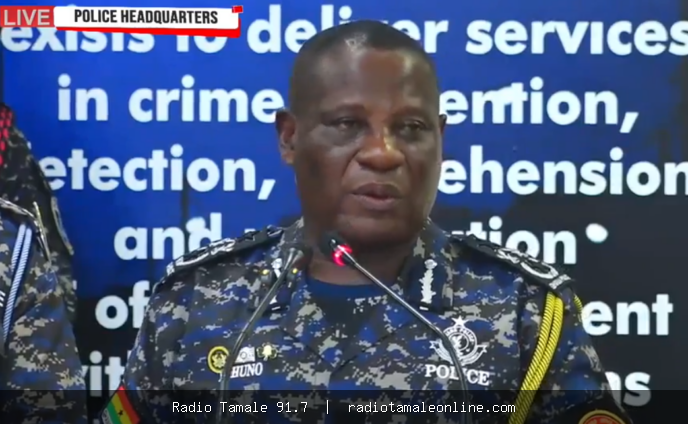
Inspector-General of Police (IGP), Christian Tetteh Yohunu, has called on religious leaders to take a more active role in promoting interfaith harmony, discouraging violence and strengthening public confidence in Ghana’s justice system.
He urged Christian and Muslim leaders to use their platforms to educate their congregations about the dangers of religious conflict and the importance of resolving disputes through lawful means.
Speaking at an engagement with religious leaders at the National Police Headquarters, the IGP said religious leaders had a crucial role to play in protecting Ghana’s peace, particularly by influencing the behaviour and attitudes of young people.
He asked the leaders to make three key commitments to help strengthen religious tolerance and social cohesion.
First, the IGP called on religious leaders to dedicate their sermons to messages that promote peace, self-control and interfaith understanding.
He urged Muslim and Christian leaders to use their regular Friday and Sunday services to speak against religious intolerance and conflict.
“Dedicate your Friday sermons in Islam, and Sunday sermons strictly to messages of interfaith harmony, self-control and the danger of religious conflict,” he said.
The IGP also urged religious leaders to remind their congregations that violence and instability would have consequences for future generations.
“Remind your congregations that an attack on the peace of Ghana is an attack on the future of their own children,” he said.
Mr Yohonu’s second call was for religious leaders to demonstrate unity publicly rather than only preaching about tolerance.
He encouraged Christian and Islamic leaders to appear together at public events, share meals and engage communities jointly.
“Let the public see Christians and Islamic leaders standing together, sharing meals, issuing joint statements and walking through our communities hand in hand,” he said.
He said such visible cooperation would send an important message to young people that religious diversity should not be a source of division.
“Show the youth that diversity of faith is strength, not a fault line,” the IGP added.
The IGP’s third appeal was for religious leaders and their congregations to have confidence in Ghana’s statutory justice system and discourage attempts to take the law into their own hands.
He urged religious leaders to teach their followers that allegations of wrongdoing should be handled through the appropriate state institutions rather than through mob action, online abuse or physical violence.
“Reaffirm trust in statutory justice, online harassment or physical violence,” he said.
He said that allowing the state to investigate and resolve disputes was an important part of responsible citizenship.
“Teach them that trusting the state to resolve offences is a mark of civic maturity and religious wisdom,” he said.
Mr Yohunu also warned that Ghana must not take its peace for granted, pointing to conflicts in other parts of West Africa where tensions had been allowed to escalate.
He said small disputes could become major conflicts if they were not addressed through dialogue and peaceful means.
“Just look around our West African subregion. We see nations where small sparks were allowed to fester until they grew into infernos of civil strife, destroying communities, markets, schools and places of worship,” he said.
According to the IGP, Ghana’s relative peace has been sustained because previous generations chose dialogue and cooperation over violence.
“Ghana has been spared this tragedy not because we are immune to disagreement, but because generations before us chose to dialogue over destruction and brotherhood over peace,” he said.
He urged religious leaders to use the engagement as an opportunity to help end hostility and reinforce confidence in the law.
“Let us make this matter serve as a clear reminder that the law works and let this meeting mark the end of hostility,” he said.

0 Comments