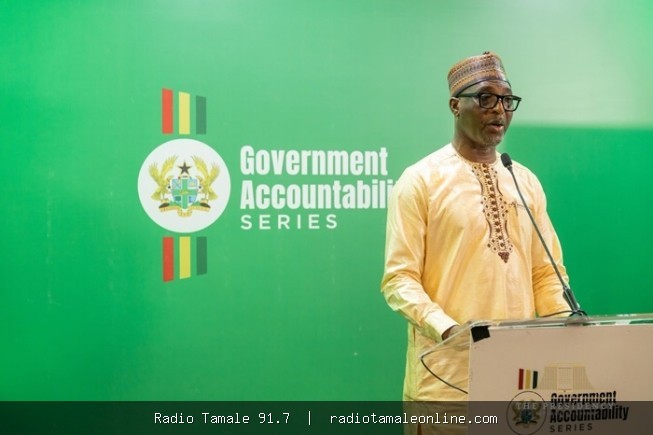
Motorists across the country will no longer be subjected to routine roadside checks by police personnel from the Motor Traffic and Transport Department (MTTD) from September 2026 as the government introduces a digital system to detect and enforce more than 47 road traffic offences, the Minister for the Interior, Muntaka Mohammed-Mubarak has said.
Under the new system, cameras and other digital devices will capture traffic violations, while police personnel will review the footage from a central control room before electronic notices are sent to offenders.
Addressing a press briefing in Accra on Monday (Aug 24, 2026), the Minister for the Interior, Muntaka Mohammed-Mubarak, said the move formed part of efforts to modernise traffic enforcement and reduce direct contact between motorists and police officers.
Mr Mohammed-Mubarak said the Motor Traffic and Transport Department (MTTD) would deploy face cameras, mobile cameras, in-vehicle cameras, handheld devices and radar systems to detect offences.
He said the system would become fully operational from September 2026, after which officers would stop carrying out manual roadside checks for the offences covered by the system.
Mr Mohammed-Mubarak said once an offence had been captured, the footage would be reviewed at a back-office control room.
After the offence had been verified, the offender would receive an electronic notice on their phone indicating the offence committed, the applicable penalty and how to make payment.
Driving licence
Responding to questions from journalists, Mr Mohammed-Mubarak said police officers would no longer stop motorists to physically inspect driving licences.
"They won't come and ask you to bring your driving licence," he said.
He said officers would also stop pulling motorists over to check seatbelt use or insurance, since such offences would be detected by the digital system.
According to him, motorists who stop at toll booths would instead receive electronic notifications if an offence had already been recorded against their vehicles.
The Minister said the new system would also help reduce opportunities for corruption during traffic enforcement.
He was responding to a question on recent Ghana Statistical Service data which ranked the MTTD, general duty officers and the Criminal Investigation Department among units perceived as being more corrupt within the Police Service at the press briefing dubbed "Government Accountability Series".
Mr Mohammed-Mubarak said removing face-to-face contact between police officers and motorists would reduce opportunities for some officers and offenders to negotiate their way out of prosecution.
He cited small payments of "five cedis or ten cedis" which, he said, had previously allowed some motorists to avoid prosecution for traffic offences.
Digitalisation
Mr Mohammed-Mubarak also linked the traffic enforcement system to the Ministry's wider digitalisation programme.
He said revenue from some services which previously took a full year to collect was now being collected within a single quarter after the services were digitalised.
He clarified that the increase did not necessarily mean people had been stealing revenue.
"I am not saying that people are stealing the money," he said, explaining that the improved collections were due to the closure of administrative loopholes.
When asked how the digital system would prevent an MTTD officer from demanding money from a motorist at a checkpoint, Mr Mohammed-Mubarak reiterated that manual document checks would be removed from September.
He also urged members of the public to submit suggestions on how to close any remaining gaps in the system.
He said the Ministry "would be more than happy to receive" such suggestions.
Other systems
The traffic camera system forms part of a wider digital reform programme being implemented by the Ministry of the Interior.
Mr Mohammed-Mubarak said an automated fire safety compliance system would begin rolling out by the end of August 2026.
He also said a National Crime Automated Biometric Identification System was being introduced and was expected to reach 751 centres across the country by the end of the year.
Source: Graphiconline











0 Comments