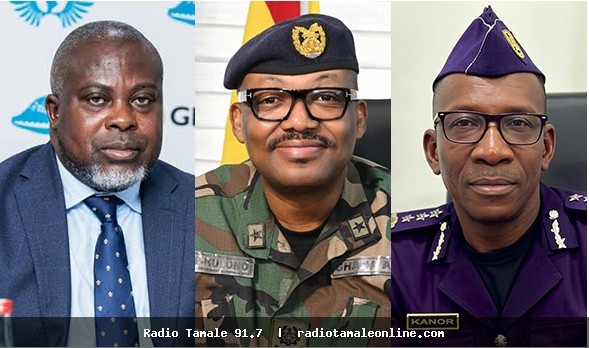
A committee established by the Commissioner-General of the Ghana Revenue Authority (GRA), Anthony Kwasi Sarpong, to investigate the disappearance and movement of containers at Ghana’s ports has engaged the Ghana Ports and Harbours Authority (GPHA) and questioned clearing agents as part of its investigations.
The committee is examining how containers may have left the ports without completing the required customs clearance and shipping procedures, raising questions about port security and the oversight of cargo movements.
Sources familiar with the inquiry said the committee had written to the GPHA and was engaging both local clearing agents and agents handling cargo destined for Sahelian countries.
The investigation comes amid concerns about containers reportedly missing, emptied, or moved from designated locations at the ports, as well as questions about the circumstances under which certain cargoes were handled.
One issue emerging from the inquiry concerns the treatment of trans-shipment containers, which are temporarily kept at a port before being transported to their final destinations.
A source familiar with the matter explained that some containers arriving at Ghanaian ports were not intended for the domestic market or for onward transportation to Sahelian countries.
In some cases, containers might be temporarily discharged at a port because of shipping arrangements, operational considerations or the relatively small volume of cargo destined for a particular location.
Such containers could subsequently be collected by another vessel belonging to the same shipping company or an associated operator and transported to their final destinations.
The source argued that cargo awaiting transshipment should not automatically be treated as abandoned or liable for confiscation merely because it had remained at the port for some time.
According to the source, shipping companies might consolidate several containers before dispatching them to their intended destinations, making temporary storage at an intermediate port necessary.
The source warned that such cargo should be distinguished from goods imported into Ghana for domestic consumption or containers intended for onward transportation to landlocked countries in the Sahel.
The source also raised concerns about the procedures governing the confiscation and auction of uncleared cargo at the ports.
According to the account, containers must satisfy the applicable legal and administrative requirements before they can be auctioned by the Confiscated Assets Committee.
These include the necessary customs processes, publication in the Government Gazette where required, and consultations involving the relevant institutions responsible for the disposal of confiscated goods.
The source maintained that the appropriate procedures must be completed before any container can lawfully be treated as confiscated property for auction.
The source further alleged that some officials had been identifying containers that had remained at the port for extended periods and seeking to have them removed without following the required procedures.
The allegations could not be independently verified, and it was not immediately clear whether the committee had established any breaches of the applicable rules.
The source further alleged that an official identified as Elizabeth Agbenousi had come under pressure to sign documents relating to some of the containers.
According to the source, the documents could potentially be used to justify or regularise the movement of the cargo.
The source claimed to have cautioned the official against signing documents without proper authorisation and said there were conflicting accounts about whether she had eventually signed some of them.
The allegations could not be independently confirmed, and it was not clear whether the official had lodged a formal complaint or whether the committee was investigating the matter.
The Herald could not independently establish the nature of the documents, the identities of the persons allegedly involved in the pressure, or whether any disciplinary action had been initiated.
The source also questioned whether the movement of containers at the ports could have occurred without the knowledge of the relevant security agencies.
Apart from the GPHA, which is responsible for port operations and security within its remit, the source noted that national security personnel also operate at the ports.
The investigation is therefore expected to raise broader questions about the respective responsibilities of the agencies involved in monitoring cargo movements, enforcing customs requirements and preventing unauthorised removal of containers.
The precise scope of the committee’s findings, however, remains unclear.
The committee was established by the Commissioner-General of the GRA to examine the circumstances surrounding the missing containers and related port operations.
According to the source, its membership includes the Commissioner-General as chairman, the Deputy Commissioner for Operations, the Commissioner responsible for Preventive operations, other customs officials and representatives from relevant departments.
The source also mentioned officials identified as Charles Agbeke, Alphonse Kwenu and Freeman, although their full names, official positions and specific responsibilities on the committee could not be independently established.
The Herald was unable to independently verify the complete membership of the committee or obtain an official statement detailing its terms of reference and expected completion date.
The committee’s findings are expected to be significant for determining whether the disputed container movements resulted from administrative lapses, breaches of customs procedures or possible misconduct by officials or private operators.
The GRA, GPHA and other agencies implicated in the allegations will need to clarify the circumstances surrounding the containers and indicate whether any irregularities have been established.
The Commissioner-General of the Ghana Revenue Authority (GRA), Anthony Kwasi Sarpong, constituted a nine-member investigative committee to probe allegations regarding the unauthorized removal, transfer, and disappearance of 28 containers at the Tema Port.
The decision follows a petition dated September 29, 2026, submitted to the Commissioner-General by a coalition of importers and clearing representatives who raised alarms over the location of their cargo.
According to the petition, filed by agents Elvis Kwabena Awuah and Ibrahim Amadou alongside importer representatives Amadu Diande and Amadou Diiguba, the affected consignments were at various stages of the customs clearance process before vanishing.
The petitioners cited multiple Bill of Lading numbers and revealed that the missing cargo contained high-value goods, including cyanide, condensed milk, sardines, alcohol, textiles, pharmaceuticals, black pepper, and tomato paste.
The petitioners alleged that some containers were found completely emptied, while others were unlawfully offloaded into private warehouses near the GHACEM enclave or moved out of the port entirely without their knowledge
“Management considers these allegations extremely serious because of their direct implications for revenue assurance, port security, and the overall reputation of the GRA,” stated Mr. Sarpong during the committee’s inaugural directive.
The matter has also been reported to the Tema Regional Police Command. Police sources confirm that preliminary arrests have been made, with suspects currently out on police inquiry bail while investigations continue.
High-Powered Panel
To ensure a comprehensive probe, the Commissioner-General appointed the Commissioner of Customs, Mr. Aaron Kanor, to chair the Fact-Finding and Investigative Committee.
Technical Advisor to the Commissioner-General. Elsie Appau-Klu will serve as Member and Secretary.
The panel also brings together key technical heads across the revenue agency, including Freeman Sarbah (Head of Legal), Theresa Potakey (Head of Customs Port Operations), Alphonse Quainoo (Head of Post Clearance Audit), Charles Agbeko (Head of Preventive), Divine Agbeko (Head of Policy & Programmes), Patrick Intarmah (Head of Investigations, EGG), Gerald Agbetor (ICUMS System Administrator).
The committee will receive technical support from Assistant Commissioner Diana Ayorkor Agbenyega (DMCE).
The investigative panel has been given a strict 14-day deadline from the date of the memorandum to complete its work and submit a final report.
As part of its terms of reference, the panel is tasked with establishing the physical status and location of all 28 containers. Members will conduct an exhaustive review of data trails on the Integrated Customs Management System ICUMS), inspecting Uncleared Cargo List (UCL records, gazetting processes, and gate-out logs tied to the affected Bills of Lading.
“The committee must determine whether standard customs clearance procedures were breached, identify any GRA officers or external collaborators involved, and establish the exact extent of revenue losses to recommend recovery measures,” Mr. Sarpong directed.
He added that the panel will specifically examine allegations of cartel activity and the purported misuse of high-ranking officials’ names to bypass port protocols. Beyond assigning liability, the team is expected to propose systemic and administrative reforms to seal security loopholes at the country’s main sea trade hub.
“All heads of divisions of the Tema Collection and external port stakeholders are hereby directed to provide the committee with maximum cooperation,’ the Commissioner-General emphasized.


0 Comments