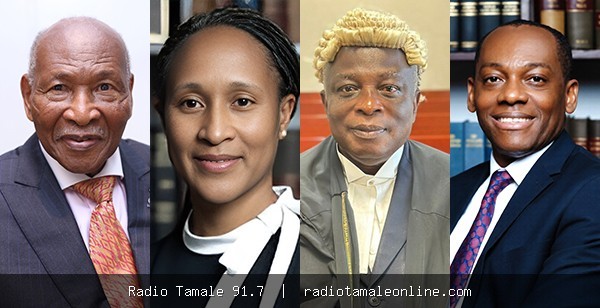
The legal dispute involving the 91-year-old veteran lawyer Sam Okudzeto and his law firm, Sam Okudzeto & Associates, has taken a new turn, with Peter Kweku Okudzeto accusing them of employing delay tactics in an appeal before the Supreme Court.
Peter explained that he was compelled to pay GH¢7,374.60 towards the preparation of the record of appeal and security for costs on behalf of Sam, his daughter, Esine Okudzeto, and their law firm, after they allegedly failed to fulfill their procedural obligations.
In an affidavit opposing an application for the rectification of the record of appeal and an extension of time, Peter argues that the payments were necessary to prevent further delays in the determination of the appeal at the Supreme Court.
Documents filed at both the Appeals Court and the Supreme Court, and sighted by The Herald, reveal disagreements over the preparation of the record of appeal, the payment of associated costs, and the composition of the parties to the underlying suit.
At the centre of the latest dispute is an application by Sam Okudzeto, Sam Okudzeto & Associates and Esine Okudzeto seeking corrections to the record of appeal and an extension of time to file their statement of case.
The substantive dispute concerns allegations of fraud, the alleged forgery of a Will, intermeddling in the estates, and the undervaluation of properties belonging to the estates of the late Baby Angelina Mamle Siaw Sappore and the late Dr Daniel Narh Siaw, who were clients of Sam Okudzeto’s law firm.
Peter, suing on his own behalf and on behalf of two other children of the late Christiana Aku Siaw Sappor, Thomas Sekou and Felicia Sekou, accused Sam and four others of forgery, inheritance fraud and intermeddling in the estates of their late aunt and uncle, including assigning one of the properties to Esine, although she is not a member of the Sappor family.
The plaintiffs also sought an order compelling the fourth and fifth defendants, Eric Akwetey Siaw Sappor and Charles Noble Doe Acolatse, respectively, to return letters of administration granted in July 2024 to the Probate Registry.
In his affidavit, Peter said he had paid the costs of preparing the record of appeal and the security for costs on behalf of Sam, Esine, and the law firm, the first, second, and third defendants, respectively.
The payment assessment, dated August 6, 2026, indicates a total of GH¢7,374.60, comprising GH¢2,897.84 in revenue, GH¢326.01 as a deposit and GH¢4,020.75 for the Appeal Centre.
Peter attached copies of the official receipts to his affidavit as Exhibit PK 3, describing them as documentary evidence that he had discharged obligations which, he maintains, the applicants were required to fulfill, arguing that the payments were necessary to ensure compliance with procedural requirements and prevent further delays in the proceedings.
Peter, who shares the same father as Sam, a former Ghana Bar Association (GBA) president and a former lecturer in Legal Ethics at the Ghana School of Law, maintains that Sam and his daughter have no entitlement to the disputed properties beyond any legitimate legal fees due to the law firm.
The properties in dispute include the Avenida Property, also known as Jet House, and the massive NCR Building, both at Adabraka, off Kwame Nkrumah Avenue in Accra.
Peter contends that, having discharged the financial obligations on their behalf, Sam and the other applicants should not be allowed to seek further indulgence from the Supreme Court over issues he considers procedural and immaterial to the determination of the appeal.
He further alleges that their conduct demonstrates no genuine commitment to expediting the proceedings.
In the affidavit, Peter, through his lawyers Andreas Fiadome and Eli Ahu at Kpatsa and Associates, stated that “The Plaintiff was compelled to pay, on behalf of the 1st, 2nd and 3rd Defendants/Applicants, the costs of making up the Record of Appeal and the security for costs, solely to defeat the Applicants’ calculated ploy of delay.”
He added that the applicants had been rescued from their alleged default and should not be permitted to seek further indulgence from the court, adding that copies of the receipts evidencing the payments were attached as Exhibit PK 3.
The affidavit was filed in opposition to the application by Sam, Esine, and their law firm for the rectification of the record of appeal and an extension of time after they complained and alleged missing pages and pagination errors in the record, arguing that the defects require corrective action.
Peter disputes the claim that page 94 of Volume I of the certified record of appeal is missing, insisting that the page is present, intact and legible in the certified copy served on the parties. He attached a copy of the page as Exhibit PK 1.
He argues that, even if the page were missing from the applicants’ working copy, that would not justify an extension of the statutory deadline for filing their statement of case.
According to the affidavit, the page relates to an interlocutory application seeking an order compelling the fourth and fifth defendants to return letters of administration granted in July 2024, and maintains that the issue has no material bearing on the substantive grounds of appeal and should not be used to delay the proceedings.
He also describes the alleged pagination errors in Volume II as minor clerical defects, rather than the omission or suppression of substantive court processes.
He insisted that the pleadings, written submissions, court notes, judgment and other relevant documents remain available and properly arranged in the record.
In another issue concerning the applicants’ request for additional time to file their statement of case, Peter stated that the applicants were served with Civil Form 6 on September 9, 2026, triggering a statutory 21-day period within which to file their statement of case.
He argues that the application for rectification and an extension of time is an attempt to obtain additional time by seeking to have the record returned to the Court of Appeal Registry.
He further contends that the applicants failed to attach a draft or proposed written submission to their application for an extension of time, which, in his view, undermines their request.
Peter maintains that the Supreme Court, having received the record of appeal, can correct clerical errors without returning the entire record to the Court of Appeal Registry, accusing Sam and the other of “an abuse of judicial process which this Honourable Court should not tolerate”.
According to him, “..upon service of civil Form 6 on 9th September 2026, the Applicants’ mandatory 21-day statutory timeline- strictly fixed at approximately three weeks– began to run; yet, under the guise of rectification, the Applicants seek an order of remittance to the Court of Appeal Registry that would necessitate the re-issuance of Civil Form 6 and confer upon them an additional 21 days, thereby unlawfully stretching a 21-day period into well over 60 days (more than two full months, and in practice, several months of delay). I am advised by Counsel and verily believe same to be true that this calculated stratagem is not the genuine correction of a clerical slip, but an attempt to reset the statutory clock by subterfuge, alter procedural timelines by conduct, and unconstitutionally usurp the legislative mandate of the Rules of Court Committee under Article 157(2) of the 1992 Constitution to subvert C.l. 16—an abuse of judicial process which this Honourable Court should not tolerate”.
“Furthermore, in respect of Paragraphs 5 (ii) through 5 (viii) of the Applicants’ affidavit complaining of misnumbered pages across Volume II, I state that these constitute harmless, trivial typographical misnumberings on the face of the pages that omit no substantive process or document,” he stated.
“That a careful examination shows the misnumberings follow a clear, predictable sequence across the volume, proving conclusively that no document or page of substantive effect has been excluded or suppressed from the Record of Appeal, adding that “Index to Volume 2 accurately and systematically sets out the sequence of all substantive processes.”
He is urging the Supreme Court to dismiss the application for rectification and an extension of time, arguing that the applicants have not demonstrated that the alleged defects would prevent a fair determination of the appeal.
Conflict-of-interest concerns
Peter’s affidavit also raises concerns about a potential conflict of interest involving lawyer Isaac Ofosu-Boateng, who is representing the defendants and, according to Peter, continues to act for the estates at the centre of the dispute.
Peter indicated that he intended to pursue the professional conduct issues arising from Isaac’s alleged dual role before the General Legal Council.
Sam serves on the council’s disciplinary committee as a representative of the Ghana Bar Association.
Isaac reportedly took over the estate matter from retired Supreme Court Justice Nene Amegatcher, who had handled the case before joining the apex court.
Before his appointment to the Supreme Court, Justice Amegatcher had issued a legal opinion dated December 10, 2014, addressed to the administrators of the estate of Baby Angelina Mamle Siaw Sappore.
The opinion considered the Ada system of inheritance and referred to the case of Eric Tei Akwetey Siaw & 2 Ors v Tetteh Siaw Sappore & Ano, concerning the relevant estates.
Justice Amegatcher drew on the late Supreme Court Justice A.K.P. Kludze’s 1988 book, Modern Law of Succession in Ghana, which discusses customary succession in Ghana, including inheritance practices among patrilineal communities.
He also relied on Makata v Ahorli (1956) 1 W.A.L.R. 169, in which the West African Court of Appeal considered customary inheritance among the Agave (Addah) people.
The legal opinion concluded that, under Ada customary law, Eric Tei Akwetey Siaw, Dr. Daniel Narh Siaw, and the children of Aku Sappore, Peter’s mother, were entitled to share the estate of the late Mokoledzen Siaw Sappore, alias Baby Angelina Mamle Siaw Sappore, in equal shares.
Peter maintains that the Supreme Court should prioritize the substantive issues on appeal rather than allow procedural disputes to prolong the proceedings.
The underlying proceedings include Suit No. PA/0797/2025, in which Sam Okudzeto and four others were named as defendants. A motion dated November 10, 2025, sought to compel the fourth and fifth defendants to return letters of administration granted on July 25, 2024, in Suit No. PA/0842/2024.
The matter subsequently proceeded through the Appeal Court after a High Court ruling. On June 25, 2026, the Court of Appeal directed Sam, his law firm, Esine, Eric Akwetey Siaw Sappor and Charles Noble Doe Acolatse to respond to allegations of fraud, forgery of a will and intermeddling, which it described as “grave allegations”.
Dissatisfied with the decision, which also directed that the substantive case be heard by a differently constituted High Court, Sam, his law firm, and Esine filed a notice of appeal challenging the ruling.
The notice, dated July 1, 2026, and filed on July 8, 2026, argues that the Court of Appeal erred in law in holding that the High Court had misdirected itself in exercising its judicial discretion to strike out the first, second and third defendants as proper parties to the suit.
Sam and the other appellants also contend that the Court of Appeal erred in referring the matter back to the High Court for a rehearing before a differently constituted court, despite there being no allegation or finding of bias against the trial judge, Justice Akosua Dansoa Asiama Christopher.
They are seeking an order setting aside the June 25 decision and a further order striking them out as the first, second, and third defendants in the suit. They have also indicated that additional grounds of appeal would be filed upon receipt of the judgment.
A registry search result dated October 2, 2026, has become a key document in the latest proceedings. According to Peter’s affidavit, the document records the procedural steps relating to the settlement of the record of appeal.
Peter alleges that Sam and the two other defendants failed, neglected, or refused to attend the settlement process despite a summons issued by the Registrar on July 16, 2026, directing the parties to appear.
He relies on the search result and the payment receipts to argue that the applicants should not be allowed to rely on alleged defects in the record to obtain further time.
The exhibits include the certified copy of page 94 of Volume I, the October 2 registry search result, official receipts for the preparation of the record and security for costs, and the applicants’ July 2026 notice of appeal.
The documents also include a separate notice of appeal filed by Peter at the Court of Appeal on November 25, 2025.
The Supreme Court is being asked to determine whether the Court of Appeal’s decision should stand and whether the three appellants should remain parties to the underlying suit.
The ape court is yet to set a date for Peter to establish the allegations of deliberate delay, procedural default, and conflict of interest.







0 Comments