
An analysis of the NDC Northern Regional Chairmanship contest, the power of political endorsements, grassroots mobilisation and the unpredictable mathematics of party elections.
In politics, the loudest drum does not always announce the arrival of the strongest dancer. Sometimes, the man who commands the greatest attention before the music begins is not necessarily the one who will command the dance floor when the final rhythm is played.
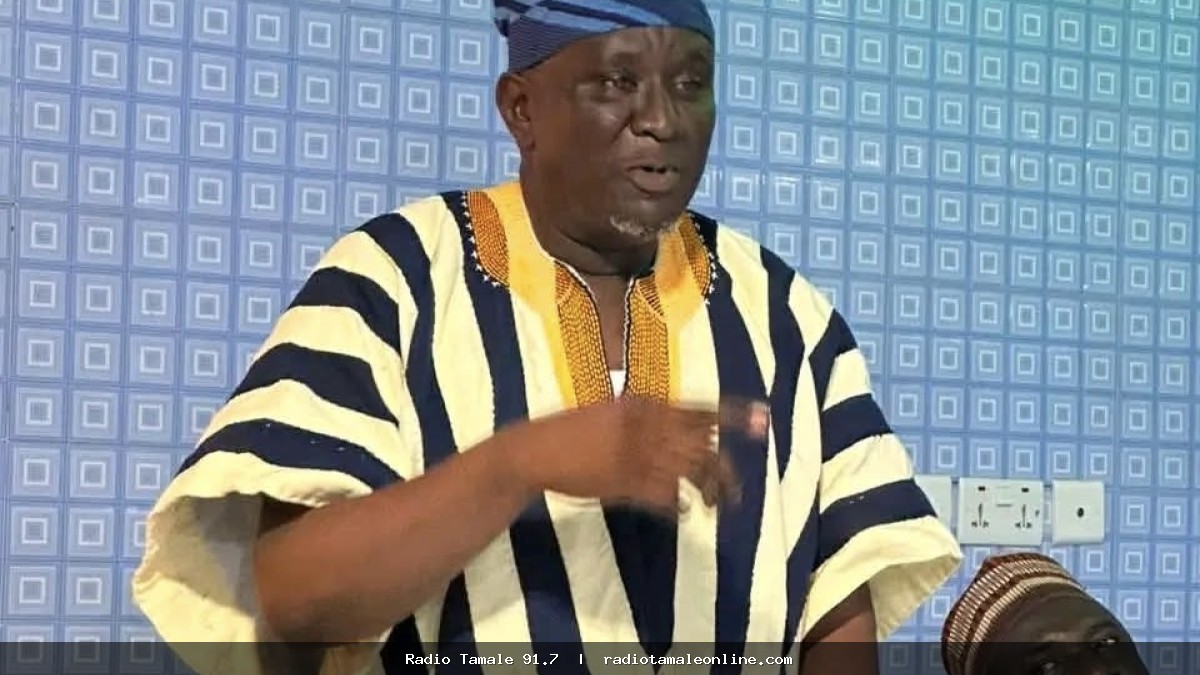
As the National Democratic Congress (NDC) prepares for its Northern Regional executive elections, the contest for the regional chairmanship presents an interesting political spectacle involving three contenders: Godfred Apasinaba Sulemana Wumbei, who occupies Number 1 on the ballot; Alhaji Tanko Maida, Number 2; and the incumbent Regional Chairman, Alhassan Abdul-Hamid, Number 3.
On the surface, the contest appears to be one in which political influence, incumbency, established networks, and grassroots appeal will collide. While Alhaji Tanko Maida is widely perceived to enjoy the formidable backing of Tamale's influential political establishment, particularly the camp associated with Hon. Haruna Iddrisu, and Chairman Alhassan Abdul-Hamid brings the advantage of incumbency and from the same camp, King Yellow represents a candidacy that deserves more than a passing glance.
Indeed, in the politics of the Northern Region, it would be premature to mistake a candidate's apparent lack of political noise for a lack of political strength.
Wumbei may not enter the race with the loudest political megaphone, but that does not mean he has nothing to say at the ballot box.
Experience, resilience and the underestimated grassroots factor
There is a compelling reason Wumbei should not be regarded as an outsider in this contest: he is not a newcomer to the politics of the NDC in the Northern Region. He is a familiar political figure whose journey within the party, previous electoral encounters, and involvement in its organisational structures give him a political foundation that cannot easily be dismissed.
Popularly associated with the name King Yellowman, Wumbei's political journey is particularly significant because he has previously contested for the same regional chairmanship position. In the 2018 regional elections, he polled 397 votes against Alhaji Ibrahim Mobila's 493. Four years later, he came remarkably close to winning, polling 236 votes against Ali Adolf's 247. That was an 11-vote difference.
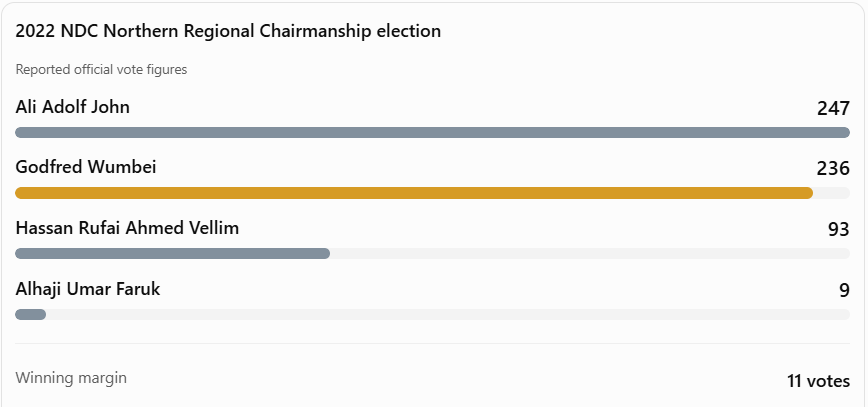
These figures tell an important story. Wumbei has demonstrated that he can assemble a considerable electoral coalition within the party. More importantly, his previous performances suggest that he has remained competitive despite not emerging victorious.
In Dagbani, there is a saying: "N-yuli ka o nyɛla, ka o tooi nya," loosely interpreted as, One's name may be known, but it is one's deeds that establish one's worth.
Wumbei's political relevance should therefore be measured not simply by the personalities standing behind him but by his history of participation, relationships within the party, and capacity to connect with delegates.
His previous narrow defeat in 2022 is particularly instructive. A candidate who comes within 11 votes of victory has already demonstrated the ability to challenge an established political structure. Such a candidate does not need to introduce himself to the electorate from scratch. He needs to consolidate his existing support, identify the gaps in his previous campaigns, and convert undecided delegates into committed voters.
That is where his opportunity lies.
The Tanko Maida factor: When political influence meets the ballot box
It would be politically naive to discuss this contest without acknowledging the considerable influence associated with Alhaji Tanko Maida's candidacy.
Number 2 on the ballot, Maida is widely perceived as enjoying the backing of Hon. Haruna Iddrisu, a towering political figure in the Northern Region and Ghana as a whole, alongside influential members of his political camp.
In Ghanaian politics, endorsements from influential political personalities are not ordinary declarations of support. They can translate into access, mobilisation, campaign resources, strategic coordination and the ability to influence conversations across party structures.
Maida's association with this political establishment gives him a significant advantage, particularly among delegates who consider political alignment, established relationships and the endorsement of influential party figures when making their choices.
His campaign has also articulated themes of unity, consolidation, and increasing the party's parliamentary representation. He has spoken about strengthening engagement between regional and constituency executives, an issue that speaks directly to the organisational needs of the party.
However, the important question is whether political endorsement automatically translates into electoral victory.
The answer is no.
A political heavyweight can influence the direction of a contest but cannot personally cast every delegate's ballot. Even where political loyalty is strong, delegates retain their individual calculations, relationships, grievances, and expectations.
There is a Dagbani expression that captures this political reality: "A person's name and influence do not necessarily mean that another person must surrender their own judgment".
Maida's perceived political backing is undoubtedly a formidable asset, but it also creates a strategic challenge: he must convince delegates that their support is founded on his own leadership credentials and vision, rather than merely their loyalty to an influential political figure.
The distinction matters because regional chairmanship is an organisational responsibility, not an extension of any individual's political influence.
The Northern Region NDC requires a chairman capable of engaging all tendencies within the party, including those who may not necessarily belong to the political camp supporting the eventual winner.
Chairman Alhassan Abdul-Hamid: The advantage and burden of incumbency
The third contender, Chairman Alhassan Abdul-Hamid, occupies a different position in this political equation.
As the incumbent, he has the advantage of visibility, familiarity with the regional executive structure and the experience of having occupied the chairmanship office. These are significant political assets.
Incumbency can provide institutional familiarity, established relationships and an opportunity to demonstrate achievements. A sitting chairman also has the benefit of being judged against an actual record rather than campaign promises alone. But incumbency is a double-edged sword.
While the office gives its occupant visibility, it also exposes him to scrutiny. Delegates may ask whether the regional party structure has become sufficiently responsive to constituency executives, whether internal disagreements have been adequately managed, and whether the party has strengthened its organisational capacity.
The incumbent must therefore defend his record while persuading delegates that another mandate would deliver improvements.
Unlike a challenger, he cannot campaign exclusively on what he intends to do. He must also account for what he has already done.
As the Dagbani proverb suggests, "N-yuli ni tooi nya ka o tooi nya," one's reputation is ultimately tested by one's actions.
For Abdul-Hamid, the central challenge is to transform incumbency into demonstrable political capital.
For Wumbei, however, the opportunity is to make the case that a fresh leadership direction, backed by experience within the party, could serve the organisation better.
Why Wumbei's chances should not be underestimated
Perhaps the most interesting aspect of Wumbei's candidacy is the possibility that his political strength may not be adequately reflected in the public noise surrounding the contest.
In internal party elections, there is often a tendency to confuse campaign visibility with actual delegate support. A candidate whose campaign dominates political conversations may appear unbeatable, while another with quieter but more extensive relationships across constituency structures may be underestimated.
This is where Wumbei's candidacy deserves serious consideration.
1. A history of competitive electoral performance
Wumbei's previous electoral record is arguably one of his strongest assets. His 236 votes in 2022, just 11 behind the eventual winner, provide a tangible indication of his ability to compete.
That result also suggests that his support base is not imaginary. He has previously attracted the confidence of a substantial number of delegates.
The question is whether he can retain those supporters while expanding his appeal to delegates who previously voted for other candidates.
2. Grassroots connections and political familiarity
Internal party elections are fundamentally different from general elections. The electorate is smaller, more identifiable, and often influenced by personal relationships, organizational experience, and direct engagement.
A candidate who has spent considerable time within party structures may enjoy relationships that are not necessarily visible in public political discussions.
Wumbei's previous service as a Regional Organiser, together with his reported involvement in national party structures, provides an important foundation for his campaign.
His challenge is to demonstrate that these relationships remain active, meaningful, and sufficiently broad across the region's 18 constituencies.
3. The advantage of being a familiar alternative
Sometimes, delegates do not necessarily seek the most politically powerful candidate. They seek someone they believe can offer a different approach to leadership.
Wumbei could position himself as an alternative for delegates who want a chairman with experience but who also desire a renewed approach to party administration.
His campaign would be strengthened by a convincing argument for inclusiveness, accessibility, accountability and stronger engagement with constituency executives.
4. The psychological advantage of being underestimated
There is an interesting political phenomenon in which a candidate who is perceived as having limited chances can gradually become a rallying point for delegates who prefer an alternative to the dominant political establishments.
If Wumbei successfully builds that perception into a credible coalition, his apparent disadvantage could become an opportunity. As the Dagbani people would say, "Zin' ni nyɛla ka o tooi nya", the one who arrives quietly may still accomplish something significant.
However, this advantage only becomes meaningful when translated into actual delegate support. Being underestimated is not itself an electoral strategy.
King Yellowman weaknesses: The realities he must confront
First of all, the challenge of political endorsements. Compared with Maida's perceived relationship with the Haruna Iddrisu political establishment, Wumbei may have to work harder to demonstrate that he has the support of influential political actors across the region. The absence of an equally visible heavyweight endorsement could affect perceptions about his electoral viability.
Secondly, the burden of previous defeats. Although his 2022 performance was impressive, his failure to secure victory after two previous attempts at the chairmanship could raise questions about whether he has the capacity to break through the political ceiling that has confronted his earlier campaigns.
Third, coalition expansion. Retaining previous supporters is not enough. He needs to attract delegates who previously supported other candidates, including those who may be comfortable with the incumbent or inclined towards Maida's political camp.
Fourth, the need for a compelling campaign message. Experience alone does not win elections. Wumbei must clearly articulate what he intends to do differently, how he will unite competing interests and how he will make the regional executive structure more effective.
His campaign must move beyond the argument that he deserves another opportunity. It must convince delegates that he has a credible plan for the party's future.
The three-way contest: What will determine the outcome?
The three candidates appear to represent different political propositions.
|
Candidate |
Ballot |
Principal political consideration |
|---|---|---|
|
Godfred Apasinaba Sulemana Wumbei |
1 |
Previous electoral strength, political experience and grassroots appeal |
|
Alhaji Tanko Maida |
2 |
Perceived heavyweight political backing and organisational relationships |
|
Alhassan Abdul-Hamid |
3 |
Incumbency, institutional familiarity and leadership record |
Ultimately, the election will depend on several factors.
The constituency factor: Which candidate can secure support across the 18 constituency structures rather than concentrate political energy in a few influential centres?
The delegate factor: Which candidate has built genuine relationships with the actual voting delegates?
The unity factor: Which candidate can convince delegates that he will accommodate different political tendencies after the elections?
The credibility factor: Which candidate has the most convincing record and vision for strengthening the party?
These considerations are particularly important because the NDC's own 2026 electoral timetable provides for regional executive elections on November 14 and 15, 2026.
It is also worth exercising caution with publicly circulated opinion polls. A Radio Tamale report published in April 2026, citing a Gariba Consult survey of 100 constituency executives, identified substantial undecided support in the regional chairmanship race. However, the candidates named in that survey were different from the three contenders considered in this analysis. Its figures should therefore not be presented as evidence of the current standings in this particular contest.
What does the NDC need in its next Northern Regional Chairman?
Perhaps the bigger question facing delegates is not simply who is politically connected, who is already occupying the office or who has contested the position before. It is what kind of regional leadership the party needs at this particular moment.
The Northern Region remains an important political theatre for the NDC. Its regional leadership must be capable of coordinating constituency structures, managing internal disagreements, strengthening communication between national and regional executives and preparing the party for future electoral contests.
The next chairman must understand that party unity is not achieved by bringing everyone under the influence of one political personality. It is achieved by creating an environment in which different political interests feel represented and respected.
The chairman must also understand that political authority is not measured by how many people surround him during a campaign but by how effectively he can bring people together when the campaign is over.
In Dagbani, there is a popular expression: "Ninsala zuɣu yɛlima," the affairs of people require wisdom and careful handling. That is precisely the quality the next regional chairman must demonstrate.
Godfred Apasinaba Sulemana Wumbei may not currently enjoy the same level of publicly perceived heavyweight political backing as Alhaji Tanko Maida. Neither does he possess the incumbency advantage enjoyed by Chairman Alhassan Abdul-Hamid.
But elections are not won by political endorsements alone, and incumbency is not an automatic guarantee of re-election.
Wumbei's political history, previous electoral performance and familiarity with the party's structures make him a serious contender whose chances deserve careful consideration.
His 2022 performance remains a particularly important reminder. He came within 11 votes of capturing the chairmanship. That is not the record of someone who can be casually dismissed.
Indeed, if he can consolidate his previous support, broaden his appeal among constituency delegates, establish a compelling campaign message and convince undecided voters that he represents a credible alternative, he could emerge as a formidable challenger.
But he must also confront his weaknesses honestly. He needs more than sympathy for his previous defeats; he needs a convincing electoral coalition.
For Maida, the challenge is to convert political endorsements into independent delegate confidence. For Abdul-Hamid, it is to demonstrate that incumbency has delivered sufficient value to justify another mandate. For Wumbei, it is to transform his political experience and previous electoral resilience into a winning coalition.
There is a beautiful Dagbani proverb that captures the uncertainty of this contest: "Nyuɣ' din be yɛligu, o ka tiŋa pam" loosely, the head that is raised above the rest is not necessarily the one that carries the greatest wisdom.
The lesson is simple: political prominence and electoral strength are not always the same thing.
The Northern Region NDC chairmanship contest should therefore not be reduced to a contest between political godfathers and an incumbent. It is also a test of delegate confidence, organisational credibility and the ability to build consensus.
Chairman Yellowman, Number 1 on the ballot, may have an uphill climb, but he is certainly not a candidate whose chances should be buried before the ballots are counted.
After all, in politics, the race is not decided by who makes the most noise at the starting line. It is decided by who crosses the finishing line with the votes. And until that final ballot is counted, writing off Godfred Apasinaba Sulemana Wumbei would be a premature political conclusion.
Authored By: Robicon Mornahson
Editorial Note: This is an analytical feature, not a declaration of electoral standings. The reported backing of Hon. Haruna Iddrisu is characterised as a political perception rather than an independently verified endorsement.

0 Comments